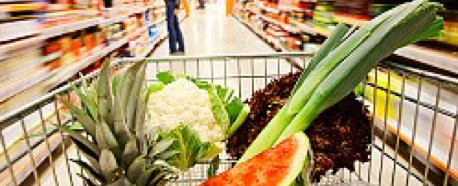
The grocery store, the lifeline of food to most Americas, is looking more and more like a repository of science experiments and pseudo-foods targeted at taking our dollars, kidnapping our taste buds, and addicting all who dare to tangle with these deceiving delicacies. Created first as a place to secure bulk staples, the building blocks of every family’s pantry, grocery stores were the much-needed lifeline to available food. Then as a one-stop shop for all food products including those previously secured from butchers and greenmarkets, supermarkets became synonymous with family food shopping. Lately though, I have been reexamining the supermarket and my relationship with it as my food evolution continues to unfold.
Here are the most basic 1-2-3’s of supermarket navigation. Start here, open your eyes to these stumbling blocks, take what is still left that is good, and you will be on your way.
Shopping Around the Perimeter
Still showcased as the healthy way to navigate a supermarket, the perimeter is the best chance you have for finding real (aka ‘unprocessed’) food there. This guidance is everywhere, however, today even the produce section, meat market and dairy aisles pose problems that you need to be aware of and manage regardless of other meat/dairy discussions left for another day. Tuck away in the back of your head that a lot of supermarket produce has become synonymous with GMO (literally meaning, genetically modified organisms), which in the US is not yet labeled and food lobbies are actively fighting allowing you to have that information and choice. Add to that the common use of chemical pesticides to create that visually beautiful bounty and the pesticide issue makes the need for your education on the perils of the perimeter even more important. To help you, I recommend carrying a photo (in your smartphone) of the Dirty Dozen and Clean15 produce lists published by the Environmental Working Group which can only help you make more informed decisions about the produce you choose to purchase. GMO and pesticide issues are further compounded in the meat and dairy aisles. How, you ask? Most animal foods sold in supermarkets come from factory farms, where livestock are fed GMO and pesticide-laden corn or soy feed alien to their digestive systems and are held in pins where no movement or fresh air allows them to live and grow. This combination impairs their health, which is then managed with antibiotics. Choosing carefully for those who are meat and dairy eaters means your first step is to choose these foods from organic, grass-fed AND pastured animals. Yes, the perimeter is often your best bet in a supermarket but still needs close monitoring and careful decision-making.
Pseudo Foods
By now we all know that Twinkies are not food, but instead are a chemical concoction. I bet you even feel safe and assured because your family would never think of eating them. But what else is right there next to Twinkies on the pseudo-food list of concoctions that you spend money on and eat regularly? The list is long and in fact even items we all grew up with that once were treats made with real raw ingredients are now vehicles for the same cheap, junk, bad-for-you stuff like high fructose corn syrup, partially hydrogenated oils and mysterious additives. (This just happened to me this week with an old standby cookie that I thought would have real ingredients. It no longer does.) Making it sound more concerning, some of these chemical foods are even banned in other countries, but not in the US. Aside from educating yourself on all these offenders, there is a super simple solution. Follow my favorite rule from Michael Pollan’s book Food Rules; Rule #11: Avoid Foods You See Advertised on Television. That should take care of most of the biggest offenders. Think about that one – advertising budgets are not usually needed for real foods but are spent mightily on high profit pseudo-foods that can be marketed effectively and have high profit margins.
Reading Labels
What if your cart is stuffed full of items that you do see on television, and you are not quite ready to let them go? Then what? Okay, if this is the case, then you must read. Reading labels is the only way to pick and chose, looking for packaged foods that are the least offensive. Since reading labels is a huge subject alone, I will only be able to touch on the basics here.
Rule 1: If you can’t pronounce an ingredient, skip the food it is in.
Rule 2: Partially hydrogenated oils are forbidden even if the front of the package says no trans fat. They are playing games with serving size to be able to make a no trans fat claim. Save your heart and arteries – no trans fat!
Rule 3: No high fructose corn syrup, even though the commercials say it is the same as sugar, it isn’t. Anyway, processed sugar is evil as well and directly linked to diabetes, heart disease, obesity and cancer.
Rule 4: If the list of ingredients is long, put that package down. The shorter the ingredients list the better. You want real foods that are as close to nature and their raw ingredients as possible.
I could go on, for example about MSG and its many alias names, what ‘natural flavoring’ really means, etc. but there isn’t enough space here for that now.
In summary, don’t be overwhelmed; start at the beginning with these basic rules and you will progress. Also, when you do, you will start noticing that your relationship with your supermarket starts to evolve and that big store doesn’t really carry much for you to eat but surely carries a lot of what companies want to sell. When that happens, head out to the farmers markets, and look up the health food stores in your area. You will be GLAD you did because they are much less work, and are not really more expensive when you consider all the money you are currently wasting on pseudo-foods and the resulting health issues they cause.
Send your thoughts and comments to blog@gladforhealth.com.


welcome about services stories contact blog reviews resources