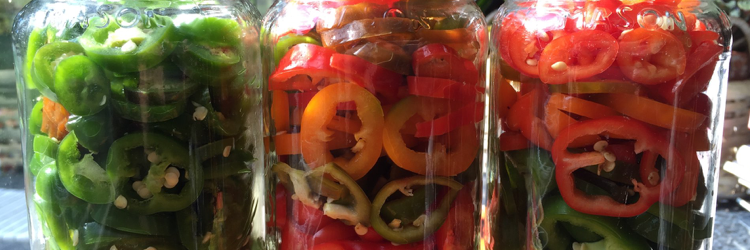

This week my CSA included pounds (yes, pounds!) of jalapeños and sweet petite peppers, leaving me in a bit of a pickle, so to speak.
While last week I got you started with my Top Tips To Handle Your Produce Bounty From A CSA Or Farmer’s Market, which would normally care for most of my needs, this time I came home realizing I needed to share more creative ways to save your produce for future use.
Multiple Ways To Preserve Fresh Produce
There are many ways to preserve including canning, dehydrating, fermenting, freezing and pickling. Here are short descriptions of each:
Canning
-
•Preserve foods by packing in heat-proof glass jars and then heating them to eliminate bacteria (pasteurization), which helps to create an air tight seal.
-
•Recipes include pickling, sweetening or keeping the vegetables as is.
-
•Can be stored in a pantry for up to one year without refrigeration.
-
•For more in depth instructions and recipes to try, Saving the Season: A Cook’s Guide to Home Canning, Pickling, and Preserving.
Dehydrating
-
•
-
•Food preservation that removes moisture from foods, which prohibits bacteria, yeast and molds from growing.
-
•Low humidity and constant temperature are needed to dehydrate.
-
•Easiest to use a food dehydrator, but you can also use an oven set at warm or up to 160 F. or simply drying in the sun for fruits (but not all vegetables).
Fermenting
-
•Uses mostly salt and sometimes some vinegar to prohibit growth of bad bacteria, but allows growth of healthy bacteria.
-
•No refrigeration is needed until the desired level of fermentation or ‘pickling’ is achieved, then refrigeration stops the process.
-
•Fermented foods are very good for gut health. Check out Dr. Mercola’s video on making easy fermented vegetables.
Freezing
-
•Leaves your vegetables and fruit close to original form.
-
•Requires prep before storage: cutting, blanching (vegetables), bagging.
-
•Cleaned, cut frozen fruits are great for smoothies and baking.
-
•Blanched, then frozen vegetables extend use and taste of just picked vegetables into the winter months.
-
•Learn more about freezing vegetables from your garden.
Pickling
-
•Pickling uses an acidic base, typically vinegar based to preserve.
-
•The basics are to fill up a container with fruit and/or veggies, layered with herbs and spices and filled with vinegar or a heated prepared brine.
Pickling can be done quickly and consumed anywhere from 3 days to a month later if prepped quickly (like these), left out to ferment for as long as a month, or prepared using canning techniques and saved for up to a year.
As you can see, there are advantages for each different way of preserving and some of these overlap. The trick is to pick the one that fits into any limitations you have and helps you prepare your vegetables or fruit for how you plan to use it later on.
For example, I was given jalapeños and peppers this week, which work well pickled and I plan to start using them right away in chile, for guacamole and on sandwiches.Plus, I am not ready to pursue a full canning project. Therefore, I have decided to do a quick refrigerator pickling of them. Here’s how.
Quick Pickled Jalapeños and Petite Peppers
Makes 3 16 oz. jars:
1 pickled jalapenos, 1 pickled pepper, 1 sweet pickled pepper
© GLAD for Health
Ingredients
3 garlic cloves, peeled and smashed
Jalapeños, sliced, about 15-20 (fills a 16 ounce jar)
Sweet petite peppers (red, orange, yellow, green), sliced, about 20-30 (fills 2 16 ounce jars)
2 cups vinegar (any kind, 5% acidity level or higher)
2 cups water (that is not chlorinated, fluorinated, etc.)
2 tbsp pickling or sea salt (no added iodine, etc.)
2 tsp sugar, plus 3 tbsp more sugar for the sweet brine (see #7)
Directions
1.Boil a large pot of water to disinfect your jars and lids. Note: this is important when not canning where everything gets disinfected in the boiling water bath. Remove and drain after disinfecting.
2.Put one crushed garlic clove in the bottom of each jar.
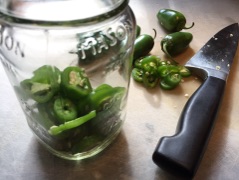
3.Slice the jalapenos into circles and stuff tightly into a jar.
4.Slice the peppers into circles and stuff into the remaining jars.
5.Make the brine. In a medium saucepan add vinegar, water, salt and 2 teaspoons of the sugar. Bring to boil just until salt and sugar dissolve.
6.Ladle hot brine into the jalapenos and one pepper jar filling to cover but leaving about ½ inch of headspace.
7.Add the additional 3 tablespoons of sugar to the remaining brine. Reheat to dissolve if necessary.
8.Ladle the sweet brine into the remaining pepper jar filling to cover but leaving a about ½ inch of headspace.
9.Cover jars with lid and ring, hand tight (if you were canning, at this point the jars would be submerged in a hot bath).
10.Invert jars for a few minutes to allow hot brine to disinfect the top of the jar.
11.Leave out to sit until cooled.
12.Store in the refrigerator.
Share your thoughts, experiences, recipes and questions about preserving, CSAs or seasonal cooking with me.
See more of my articles for FitLife.tv here.
Need help or want to comment? Email me at blog@gladforhealth.com or contact me.


welcome about services stories contact blog reviews oils resources